
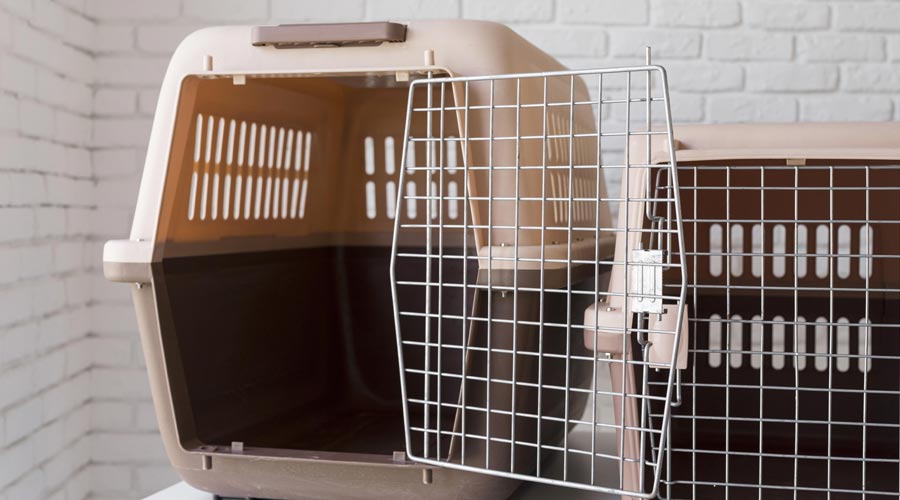
When you’re planning an international move with your dog, the flight part is likely causing you more worry than anything else.
The good news is that early crate training makes a significant difference in how your dog handles the journey. This guide covers what to do, when to start and what to get right along the way
How Long Before a Flight Should I Start Crate Training My Dog?
Start at least four to eight weeks before your dog’s flight. If your dog has separation anxiety or has never been in a carrier before, aim for 3 months, since the crate needs to feel like a familiar, safe space well before travel day.
Why Flying Can Be Hard for Dogs
Most dogs travelling internationally fly in the aircraft hold.
While pet travel is safe with the aeroplane hold being pressurised and temperature-controlled, there are no familiar smells and no visual cues that dogs can make sense of.
Dogs rely heavily on routine, but a long-haul flight strips all of that away in one go. So, for a dog that has never spent time in a pet carrier, being confined in one mid-flight adds another layer of stress on top of an already overwhelming situation.
Pet crate training deals with that specific problem by making the crate familiar before any of the other stressors come about during the flight.
Need more help...
The Reason for Pet Carrier Training
A dog that has been gradually introduced to its crate, with consistent positive reinforcement, learns to associate it with rest and safety. On the day of the flight, when everything else is new and loud and disorienting, the crate is the one thing they already know.
Any reputable pet travel company will tell you that dogs accustomed to their crates before travel are significantly less likely to experience anxiety or injury during air transport.
A Week-by-Week Dog Crate Training Plan
Here is a straightforward breakdown on how to crate train your dog before flying:
Weeks 1 to 2: Introduction
Start by putting the crate somewhere your dog already hangs out with the door open and with their usual bedding inside. Don’t ask them to go in, just let them nose around it in their own time. You could even feed them meals nearby during this stage, to create a connection between the crate and something good, without any pressure attached.
Weeks 3 to 4: Short sessions with the door closed
Once your dog is comfortable going in on their own, start closing the door for short stretches. You can use a treat or favourite toy to encourage them to go inside and open the door again before they get unsettled. How long that takes varies from dog to dog. At this stage, the sessions should end calmly, meaning if your dog goes in willingly and comes out relaxed after five minutes, they’re in a better position than one that’s been in for twenty and worked themselves up.
Weeks 5 to 6: Building duration and leaving the room
Now it’s time to gradually increase the time your dog spends in the closed crate by starting with short room-leave periods and then longer ones. You want your dog to settle in there, so if they’re scratching or whining consistently, go back to the previous step rather than pushing forward.
Weeks 7 to 8: Overnights and time alone in the house
Your dog should now be sleeping in the crate overnight and staying in it while you’re out of the house. This is as close to flight conditions as you can replicate at home, and if your dog has worked through the earlier stages, they will now go into the carrier with little persuasion.
Need more help...
Choosing the Right Pet Travel Crate for Dogs
There’s no point putting in all the effort of good training if you’re using the wrong dog travel crate. Dogs flying internationally need an IATA-compliant pet travel crate and airlines will flat-out refuse boarding if yours doesn’t comply.
Check your specific carrier’s requirements before purchasing, as they vary by airline.
Size is the most common mistake. Your dog needs to be able to stand upright, turn around and lie down in a natural position.
A pet travel crate that’s too small for your dog just adds physical discomfort to an already stressful journey. And one that’s too large undermines the training, since dogs settle better in an enclosed, den-like space. In other words, too much room and the crate stops feeling like a safe retreat.
The Role of Sedation and Calming Aids for Pet Travel
Sedation is not recommended for dogs flying in cargo. That’s because sedatives affect a dog’s ability to balance and regulate their breathing at altitude, with both carrying real risks in the hold. Luckily, most vets will advise against it.
If your dog’s anxiety is significant, ask your vet about pheromone sprays or natural calming supplements used alongside crate training. It’s also worth doing at least one car journey with the crate before the flight, because while the motion and noise of a vehicle aren’t identical to those of flying, it gives your dog practice being confined in the carrier in an unfamiliar, moving context. And if it causes any anxiety, you have time to work through it before departure.
Give Your Dog a Head Start
The dogs that travel well are the ones whose owners started crate training early.
By the time the big move comes around, the pet crate is already a place they feel settled in.
So, if you’re moving abroad with your dog, start the crate training now. It’s one of the few parts of this process that’s entirely in your hands.
Need more help...